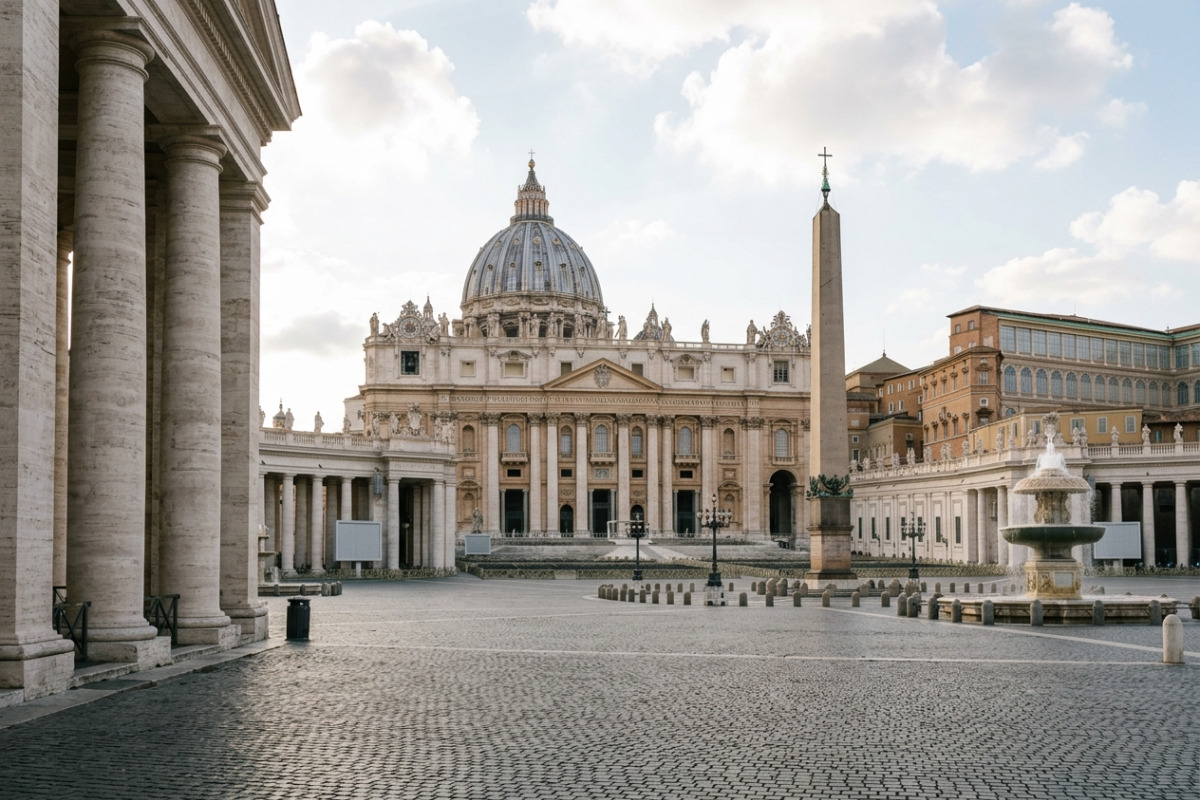
When you stand in the center of St. Peter’s Square, embraced by the colossal colonnades, you are not merely looking at a church; you are witnessing a carefully orchestrated theatrical performance in stone. St. Peter’s Basilica is widely considered the crowning achievement of Renaissance architecture, yet its final form and its soul are undeniably Baroque. This artistic style, which dominated the 17th century, was designed to evoke awe, emotion, and spiritual overwhelming. As we move through 2026, the Basilica remains a timeless lesson in how architecture can manipulate light, space, and scale to create a profound sense of the divine.
The transition from the balanced harmony of the Renaissance to the dramatic intensity of the Baroque is nowhere more visible than within these hallowed walls. While Michelangelo provided the structural skeleton with his massive dome, it was architects like Carlo Maderno and Gian Lorenzo Bernini who dressed the church in its majestic robes. For the modern traveler, understanding these architectural choices transforms a simple visit into a journey through the history of art and faith. To fully appreciate the layout before you arrive, you might want to Explore the Basilica sections online to grasp the sheer scale of the monument.
The Facade and the Theatrical Entrance
The first encounter with Baroque drama happens before you even enter the building. Carlo Maderno’s facade, completed in the early 17th century, stretched the original Greek cross design into a Latin cross, creating a massive, wide front that asserts the church's dominance. Unlike the static facades of earlier eras, Maderno’s work uses varying depths of columns and pilasters to create a play of shadow and light, a technique known as chiaroscuro. This dynamic surface makes the stone appear to be in motion, breathing with the changing sunlight of Rome. Consider the interplay of light on the travertine stone, a key element in emphasizing the Baroque dynamism.
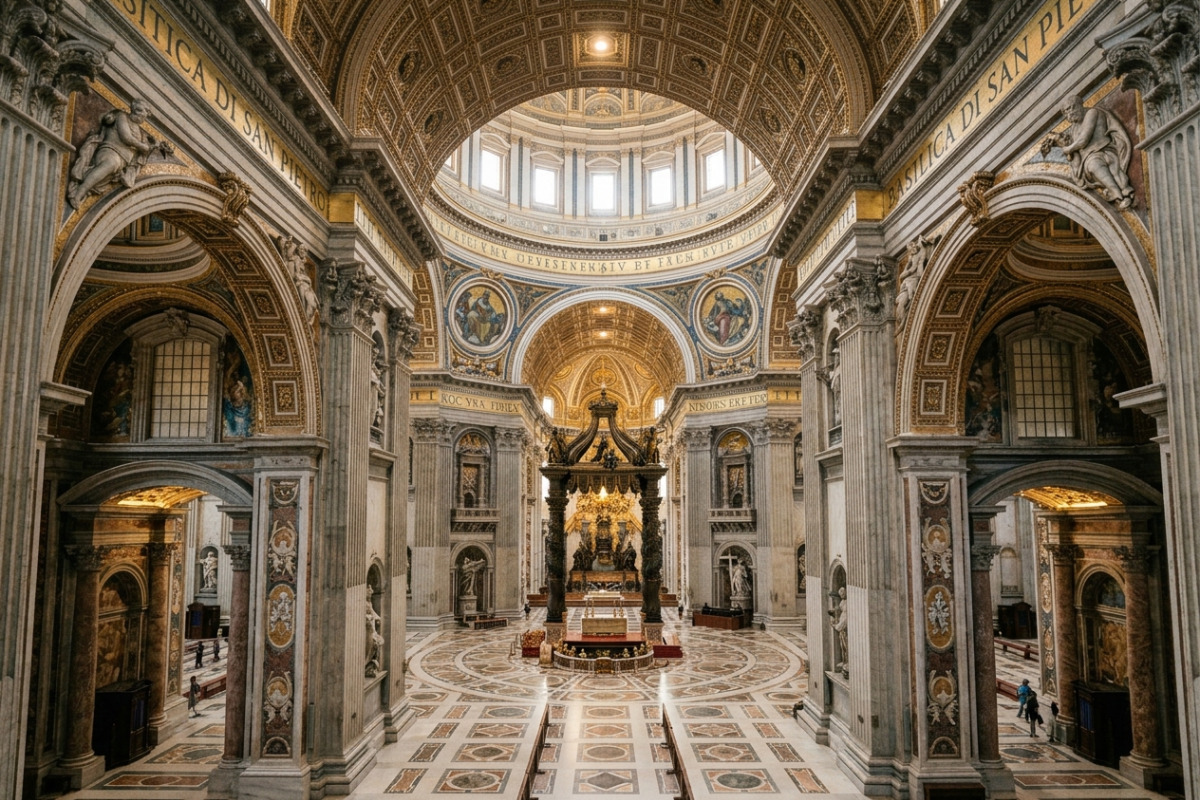
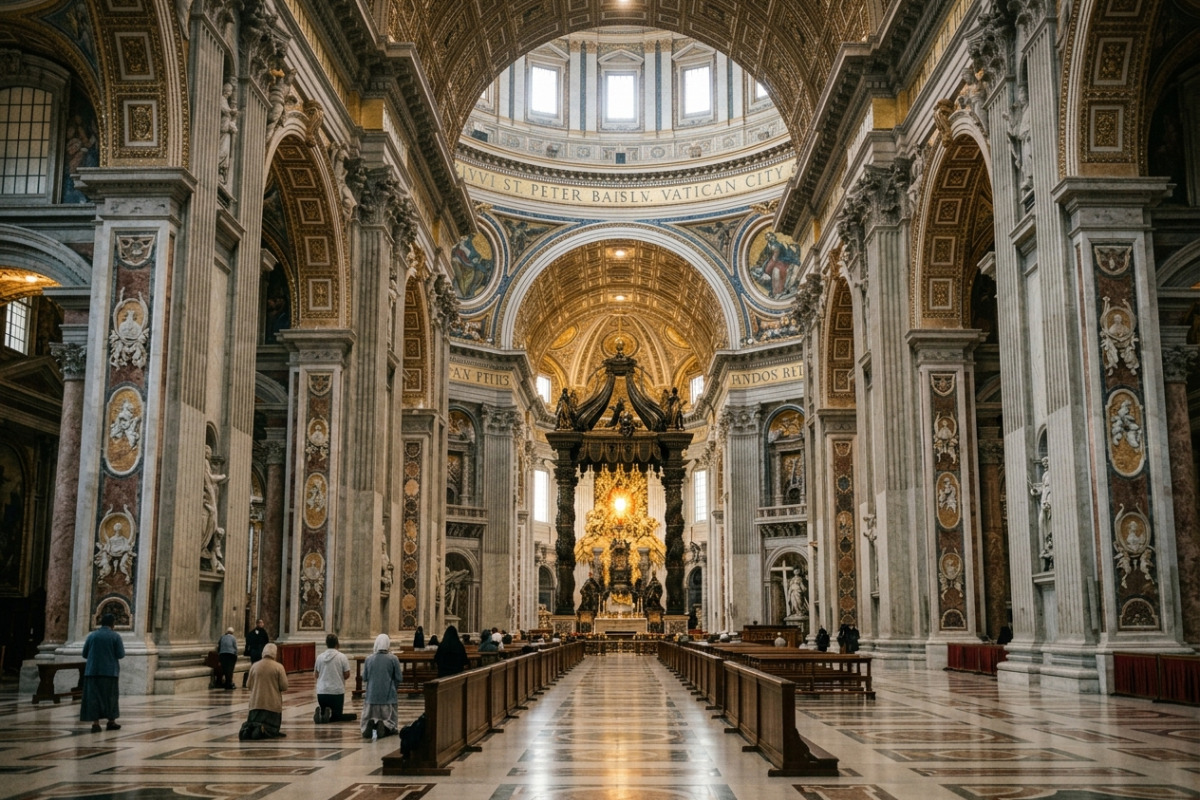
Stepping through the massive bronze doors, the nave opens up with an intensity that is meant to make the visitor feel small in the presence of God. This is a key tenet of Baroque architecture: emotional impact through grandeur. The rich decorations, the gilded stucco, and the colossal statues in the niches are not just ornamentation; they are part of a unified visual narrative. To navigate this vast space and understand the history behind the entryway, utilizing an Audio Guide App is highly recommended, as it uncovers details about the nave that the naked eye might miss. Pay close attention to the coffered ceiling, a Renaissance element, but adorned with Baroque details like the papal coat of arms.
Bernini’s Baldachin: The Heart of the Drama
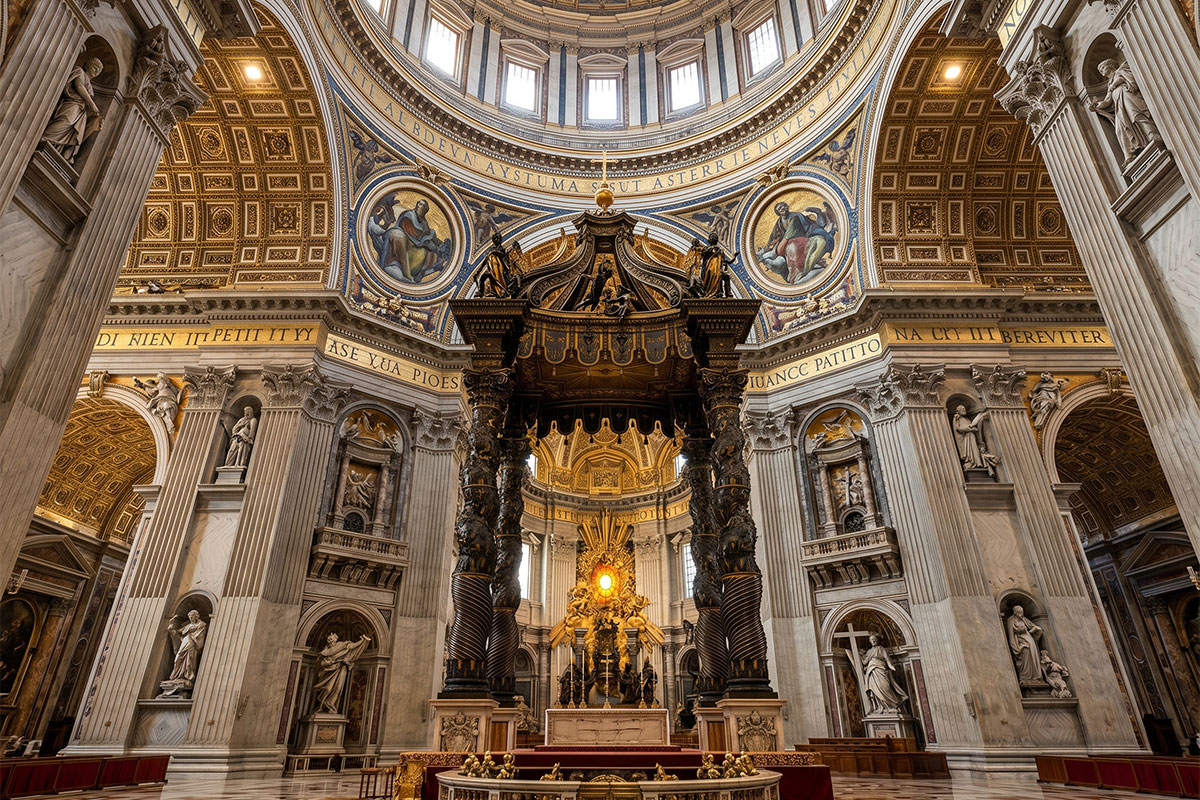
If the nave is the prelude, the crossing under the dome is the climax of the Baroque symphony. Here stands Gian Lorenzo Bernini’s Baldachin (Baldacchino), a towering bronze canopy that marks the site of St. Peter’s tomb. This structure is the definition of Baroque energy. Unlike straight classical columns, Bernini created four massive, twisting Solomonic columns that seem to spiral upward, mimicking the movement of smoke or fire. Decorated with bees (the symbol of the Barberini Pope Urban VIII) and laurel leaves, it creates a visual link between the earthly altar and the soaring dome above.
The Baldachin serves a crucial architectural purpose: it mediates the scale between the human visitor and the cavernous height of Michelangelo's dome. Without it, the altar might look insignificant in such a vast space. Just beneath this masterpiece lies The Altar of the Confessio, the holiest site in the Basilica. The interplay between the dark bronze of the canopy and the light flooding in from the dome creates a theatrical spotlight effect, focusing all attention on the sacred center.
The Cathedra Petri: Sculpture as Light
Looking past the Baldachin to the apse at the far end of the church, you encounter another Bernini masterpiece: the Cathedra Petri (Throne of St. Peter). This is pure Baroque spectacle. The bronze throne, which encases a wooden chair believed to have been used by St. Peter, appears to float in mid-air, supported by four doctors of the Church. However, the true genius lies in the window above it.
- The Dove of the Holy Spirit: Centered in an oval window made of alabaster, surrounded by golden clouds and angels.
- The Light Burst: Bernini utilized natural sunlight entering the window to make the gilded rays appear as if divine light is physically bursting into the church.
- Emotional Resonance: The entire composition dissolves the barrier between art and reality, designed to induce a state of religious ecstasy in the viewer.
The Dome: A Renaissance Structure with a Baroque Soul
While the dome was designed by Michelangelo in a Renaissance style, its completion by Giacomo della Porta and its interior decoration lean heavily into Baroque sensibilities regarding scale and perspective. It remains the tallest dome in the world and dominates the Roman skyline. The interior mosaics, which depict the celestial hierarchy, are designed to be viewed from below, drawing the eye upward to the lantern, symbolizing the ascent to heaven.
For those willing to make the climb, The Dome offers not just a view of Rome, but a close-up look at the intricate mosaics that line the interior. It is here that one realizes the "paintings" seen from the floor are actually millions of tiny tesserae, a testament to the work of the Vatican's artisans. You can learn more about this intricate craft at The Mosaic Studio, which continues to maintain these masterpieces today.
Contrasting Styles: Renaissance vs. Baroque in St. Peter's
To truly understand the unique architectural blend of the Basilica, it is helpful to look at how different elements contrast and complement each other. The Basilica is a dialogue between two great eras of art history.
| Feature | Renaissance Elements (Michelangelo/Bramante) | Baroque Elements (Bernini/Maderno) |
| Focus | Symmetry, harmony, and mathematical proportion. | Drama, movement, emotion, and theatricality. |
| Key Examples | The central Dome structure, Michelangelo's Pietà. | The Baldachin, the Colonnade outside, the Cathedra Petri. |
| Use of Light | Uniform, clear lighting to highlight form. | Dramatic, directed light (chiaroscuro) to create mystery. |
| Materiality | Emphasis on the purity of marble and stone. | Rich mixture of bronze, gold, stucco, and colored marble. |
Hidden Treasures and Historical Layers
The Baroque grandeur of the main floor is supported, quite literally, by history. Beneath the marble floors lie layers that take you back to the origins of Christianity. The Vatican Grottoes contain the tombs of popes and royals, offering a somber, quieter counterpoint to the exuberance above. Going even deeper, The Necropolis reveals the ancient Roman cemetery where St. Peter’s tomb was originally located, grounding the soaring Baroque architecture in ancient reality.
Furthermore, the artistic wealth of the Basilica extends beyond the walls into The Treasury Museum. Here, you can view liturgical ornaments, statues, and papal miters that reflect the same artistic evolution from medieval simplicity to Baroque opulence. These artifacts provide context to the ceremonies that would have taken place amidst Bernini’s dramatic sets.
Planning Your Architectural Pilgrimage
Visiting St. Peter's Basilica is an overwhelming experience, and the crowds can be as massive as the architecture itself. To appreciate the design elements without feeling rushed, it is essential to Plan Your Visit carefully. Early mornings or late afternoons are generally best for observing the play of light that Baroque architects utilized so effectively. Before you go, checking the Frequently Asked Questions can save you time regarding dress codes and security checks.
Practical Information for Visitors:
- Opening Hours: The Basilica is generally open from 7:00 AM to 7:00 PM (April to September) and 7:00 AM to 6:00 PM (October to March). However, these times can vary due to papal events and religious ceremonies. It's always best to check the official Vatican website for the most up-to-date schedule.
- Entry Fees: Entry to St. Peter's Basilica itself is free. However, there are fees for climbing the dome, visiting the Vatican Grottoes, the Treasury Museum, and the Necropolis.
- Dress Code: As a religious site, a strict dress code is enforced. Shoulders and knees must be covered. Hats are not permitted inside the Basilica.
For a seamless experience, securing Tickets & Tours in advance allows you to skip long lines and focus on the art. Whether you are captivated by the twisting bronze of the Baldachin or the serene sorrow of the Pietà, St. Peter’s remains a living textbook of artistic genius. It stands as a testament to a time when architecture was not just about building walls, but about capturing the infinite.