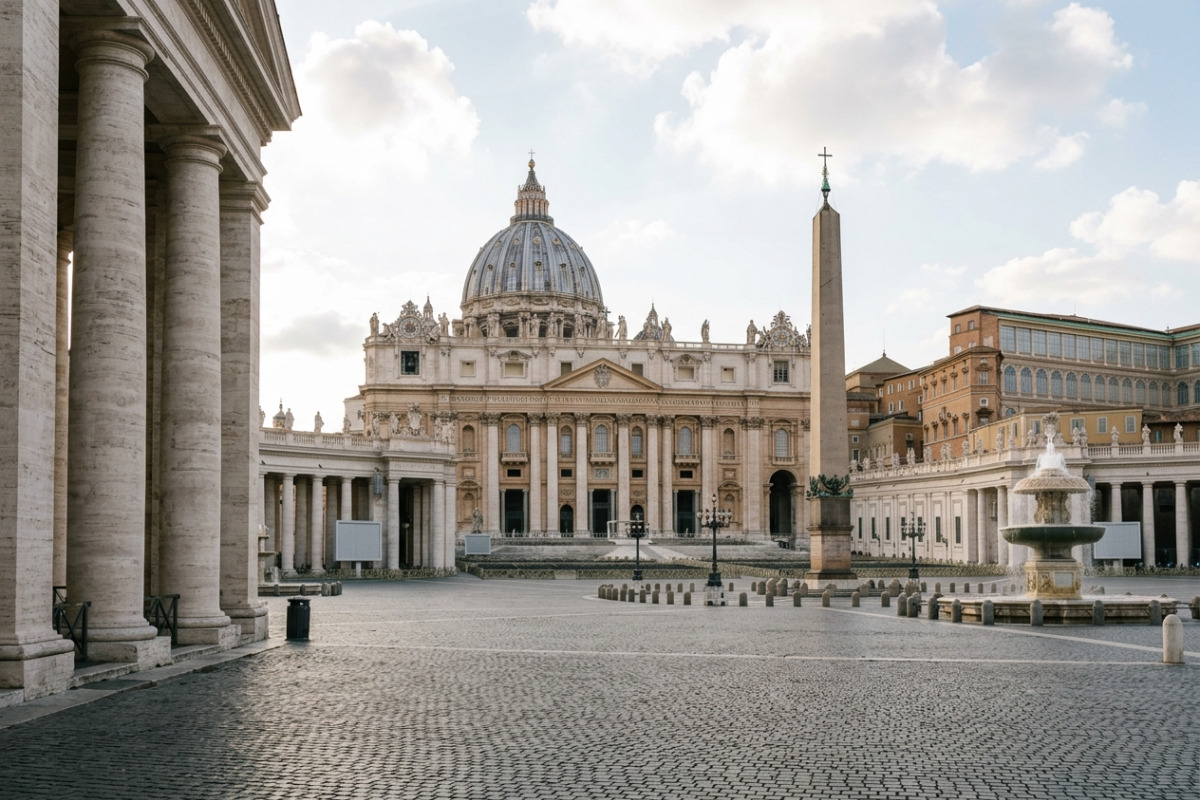
Standing in the center of St. Peter's Square, surrounded by the embracing arms of Bernini’s colonnade, one cannot help but feel the weight of history. This is not merely a church; it is a living timeline of Western art and architecture. For centuries, the greatest minds in human history—Michelangelo, Bramante, Raphael, Bernini, and Maderno—poured their genius into this sacred space. To understand the art of St. Peter’s is to understand the evolution of the Catholic Church itself, transitioning from the humble resting place of a fisherman to the majestic epicenter of Christianity. As we look at this architectural wonder in January 2026, it remains a testament to the enduring power of human creativity and faith.
The Foundations: Constantinian Origins and The Necropolis
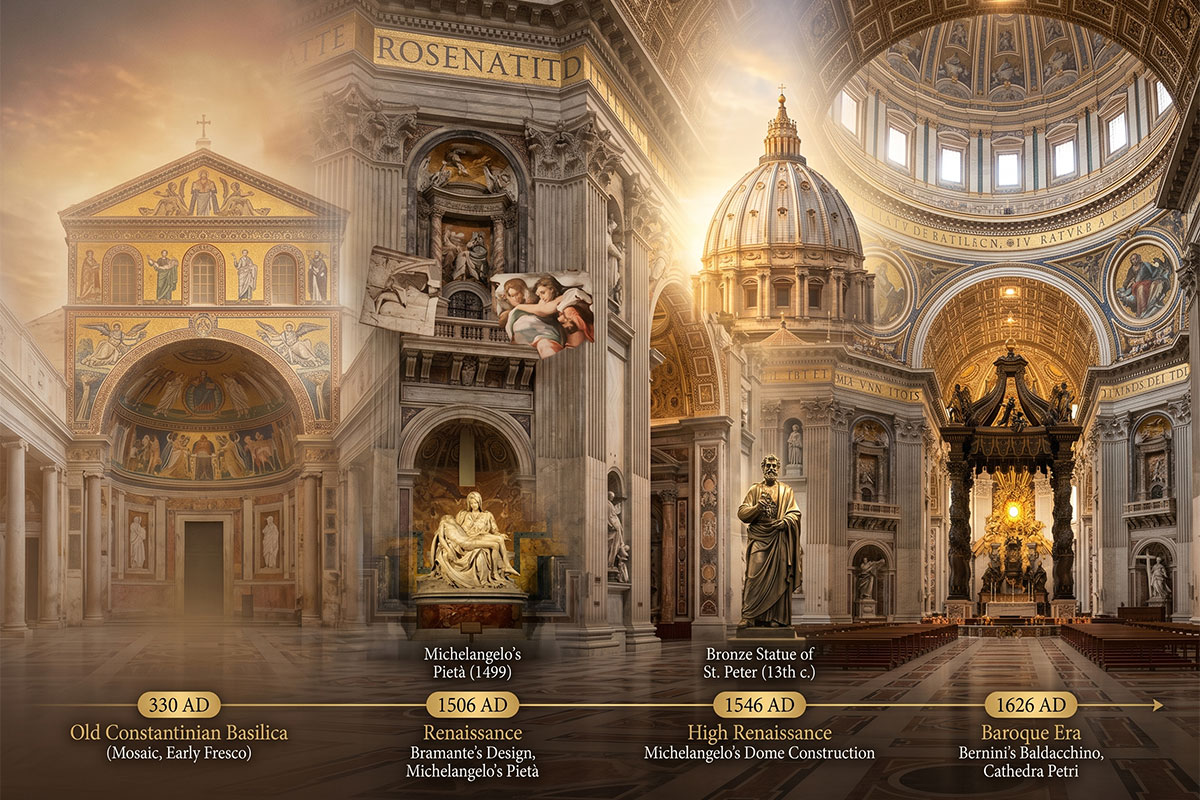
The artistic journey of the Basilica begins long before the current Renaissance structure pierced the Roman skyline. It starts deep underground. The original basilica, commissioned by Emperor Constantine in the 4th century, was a marvel of its own time, filled with frescoes and mosaics that reflected early Christian theology. While the structure we see today is relatively 'new' in the grand scheme of history, the spiritual core rests upon the The Necropolis, the city of the dead where St. Peter’s tomb was identified. The art of this era was subterranean and symbolic, focused on the afterlife and the sanctity of the martyr's grave.
Although the Old Basilica was demolished to make way for the new, traces of this ancient artistic heritage survive. Visitors who venture below the main floor can explore The Vatican Grottoes. Here, amidst the tombs of popes and kings, fragments of ancient mosaics and early sarcophagi offer a glimpse into the artistic sensibilities of the first millennium. These artifacts bridge the gap between the persecuted early church and the triumphant power it would later become.
The Renaissance Revolution: Stone into Flesh
The decision to tear down the crumbling Old St. Peter's in the 16th century sparked one of the most ambitious artistic projects in human history. The Renaissance brought a shift in focus toward humanism, symmetry, and classical beauty. This era gave us the architectural skeleton of the Basilica, but more importantly, it gave us sculpture that breathes. The most poignant example of this period is undoubtedly Michelangelo's Pietà. Carved when the artist was only in his early twenties, the marble depicts the Virgin Mary holding the lifeless body of Christ. It is a masterpiece not just of technique, but of emotion; the stone seems to yield to the touch, and the sorrow on Mary's face is timeless.
Beyond the Pietà, other Renaissance masters contributed significantly. Raphael, initially brought in by Bramante, worked on the designs for the Basilica before his untimely death. Though little of his direct architectural work remains visible in the final structure, his influence on the overall artistic vision is undeniable. Similarly, Donato Bramante's early designs, though altered by subsequent architects, laid the groundwork for the grand scale of the new Basilica.
While the Pietà captures intimate sorrow, the architecture aimed for the heavens. The design of the massive cupola changed the artistic landscape of Rome forever. To fully appreciate the engineering and artistic vision of Michelangelo, many visitors choose to climb The Dome. From the interior walkway, you can see the mosaics up close, realizing the sheer scale of the evangelists depicted there, before stepping out to view the Eternal City—a living canvas that the Basilica watches over.
Key Artistic Shifts During the Renaissance
- Humanism in Sculpture: Moving away from stiff, symbolic figures to anatomically perfect, emotional representations.
- Architectural Symmetry: The use of Greek Cross plans (initially) and perfect circles, symbolizing the perfection of God.
- Classical Influence: The revival of Roman columns, pediments, and domes inspired by the Pantheon.
The Baroque Theatrics: Bernini’s Grandeur
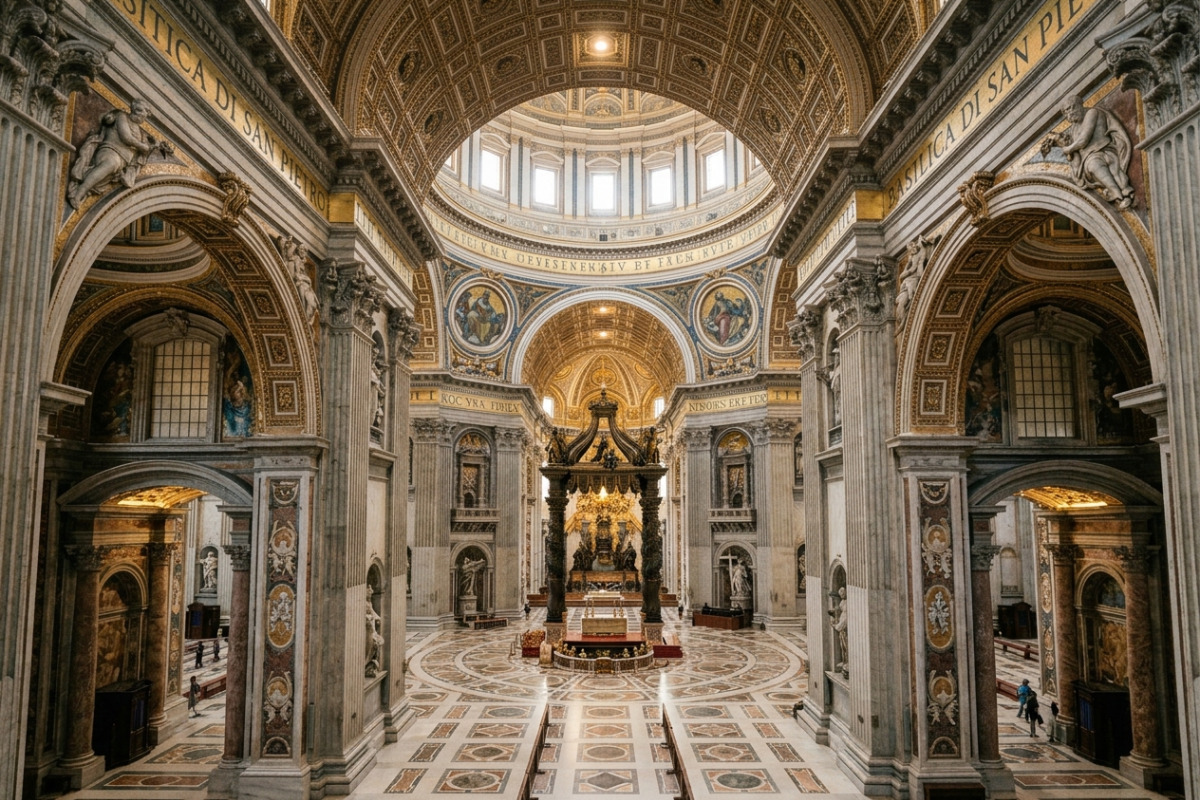
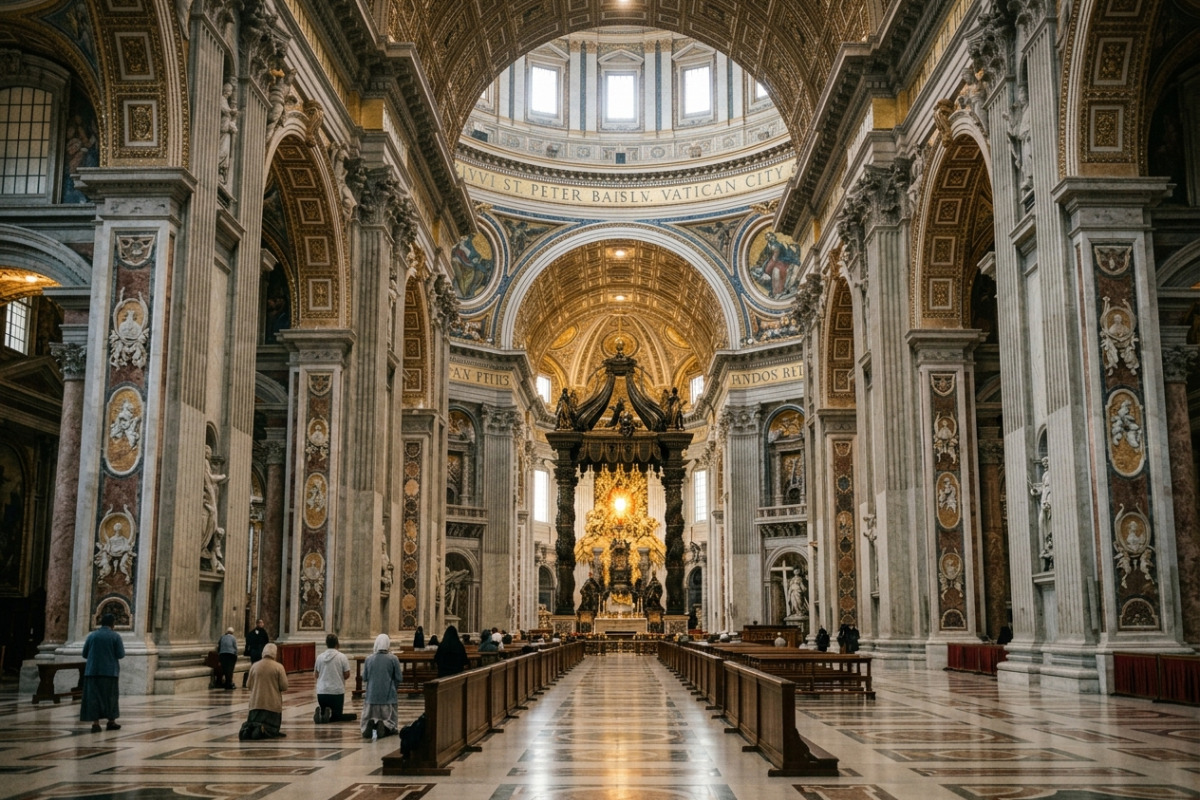
If the Renaissance provided the structure and the soul, the Baroque era provided the drama. As the 17th century approached, the Church sought to counter the Reformation with art that was awe-inspiring, theatrical, and overwhelming. Enter Gian Lorenzo Bernini. His influence is felt in every corner of the nave. His defining contribution is The Altar of the Confessio, crowned by the massive bronze Baldachin. Standing over 29 meters tall, its twisted columns direct the eye upward to the dome, creating a vertical connection between the tomb of Peter and the heavens.
Bernini’s art was about movement and light. He transformed the apse with the Cathedra Petri (Chair of St. Peter), a riot of gilded bronze and stucco clouds that seem to float in the divine light of the stained glass window. This was a departure from the static calm of the Renaissance; it was art designed to make the viewer feel small in the presence of the divine. Beyond the Baldachin and the Cathedra Petri, Bernini also designed numerous tombs and sculptures within the Basilica, including the Tomb of Pope Alexander VII, a dramatic depiction of death and salvation.
Another key figure of the Baroque era at St. Peter's was Carlo Maderno, who extended the nave of the Basilica, transforming it from a Greek cross plan to a Latin cross. This change, while architecturally significant, also impacted the viewing experience, creating a longer processional space.
Comparing the Eras
| Feature | Renaissance Style | Baroque Style |
| Focus | Harmony, Proportion, Logic | Emotion, Drama, Movement |
| Key Material | White Marble, Travertine | Gilded Bronze, Colored Marble, Stucco |
| Example | Michelangelo's Pietà | Bernini's Baldachin |
| Atmosphere | Serene and Contemplative | Grand and Theatrical |
The Illusion of Painting: The Mosaic Legacy
One of the most surprising facts for visitors as they Explore the Basilica is that there are almost no paintings on the walls. What appear to be oil paintings are actually intricate mosaics. In the humid environment of the Basilica, canvas and fresco were prone to decay. Consequently, the Vatican established a workshop dedicated to reproducing great paintings in glass and stone, ensuring they would last for eternity. This tradition continues today at The Mosaic Studio, where artisans still use centuries-old techniques to restore and create works for the Vatican.
The transition to mosaic allowed for a vibrancy of color that reflects the light flooding in from the dome, contributing to the ethereal atmosphere of the interior. When you view the massive altar pieces, remember that you are looking at thousands of tiny tesserae, pieced together to defy the ravages of time.
Hidden Gems: The Treasury and Minor Arts
The artistic evolution of St. Peter's is not limited to giant structures. The devotion of centuries has filled the Basilica with liturgical objects of immense beauty. The Treasury Museum holds a collection that traces the history of the church through precious metals, gemstones, and textiles. From the Crux Vaticana (the oldest cross in the collection) to elaborate papal tiaras, these objects show a different side of artistic evolution—one focused on craftsmanship and detail on a miniature scale. These artifacts remind us that art in St. Peter's served a functional, liturgical purpose, enhancing the rituals that took place within these walls.
Experiencing the Art Today
Understanding the layers of history at St. Peter's can be overwhelming. The Basilica is a dense text of symbols, history, and artistic rivalry. To truly appreciate the nuance between a Renaissance arch and a Baroque embellishment, using digital tools can be incredibly helpful. The official Audio Guide App provides the narrative thread that connects these disparate eras, explaining the context behind the visual splendor.
For those wishing to see these masterpieces in person, it is essential to Plan Your Visit carefully. The sheer size of the Basilica means that missing key artworks is easy if you wander aimlessly. Whether you are interested in the engineering of the dome or the spiritual depth of the necropolis, securing Tickets & Tours in advance ensures you have the access needed to experience the full breadth of this artistic legacy.
As we move further into the 21st century, St. Peter's Basilica remains a dynamic monument. It is not a museum where art goes to retire, but a living church where the artistic dialogue between the past and present continues. If you have more questions about logistics or specific access, the Frequently Asked Questions section is a great resource to ensure your pilgrimage to this temple of art is seamless.