When you step across the threshold of St. Peter's Basilica, the immediate sensation is one of overwhelming magnitude. Yet, beneath the gold leaf, the marble veneers, and the colossal statues, there lies a rigorous intellectual skeleton: geometry. The basilica is not merely a collection of artistic masterpieces; it is a calculated spatial narrative where circles, squares, and crosses interact to direct the human spirit. As visitors continue to marvel at this architectural wonder, it becomes clear that the structure was designed to orchestrate movement, guiding the pilgrim from the earthly realm of the portico to the celestial aspiration of the dome.
The Battle of Shapes: The Evolution of the Floor Plan
The footprint of St. Peter's Basilica as we see it today is the result of a century-long dialogue between two competing geometric ideals: the Greek Cross and the Latin Cross. Initially, Donato Bramante envisioned a structure of perfect symmetry—a Greek Cross where four equal arms radiated from a central dome. This design was deeply symbolic, representing the perfection of God and the cosmos, with no beginning and no end. It was a plan grounded in the Renaissance obsession with the circle and the square, shapes that were considered divinely rational. Bramante's initial design, influenced by his study of classical architecture, aimed to create a harmonious and centralized space, reflecting the Renaissance ideals of order and proportion.
From Greek to Latin: Adapting to Liturgical Needs
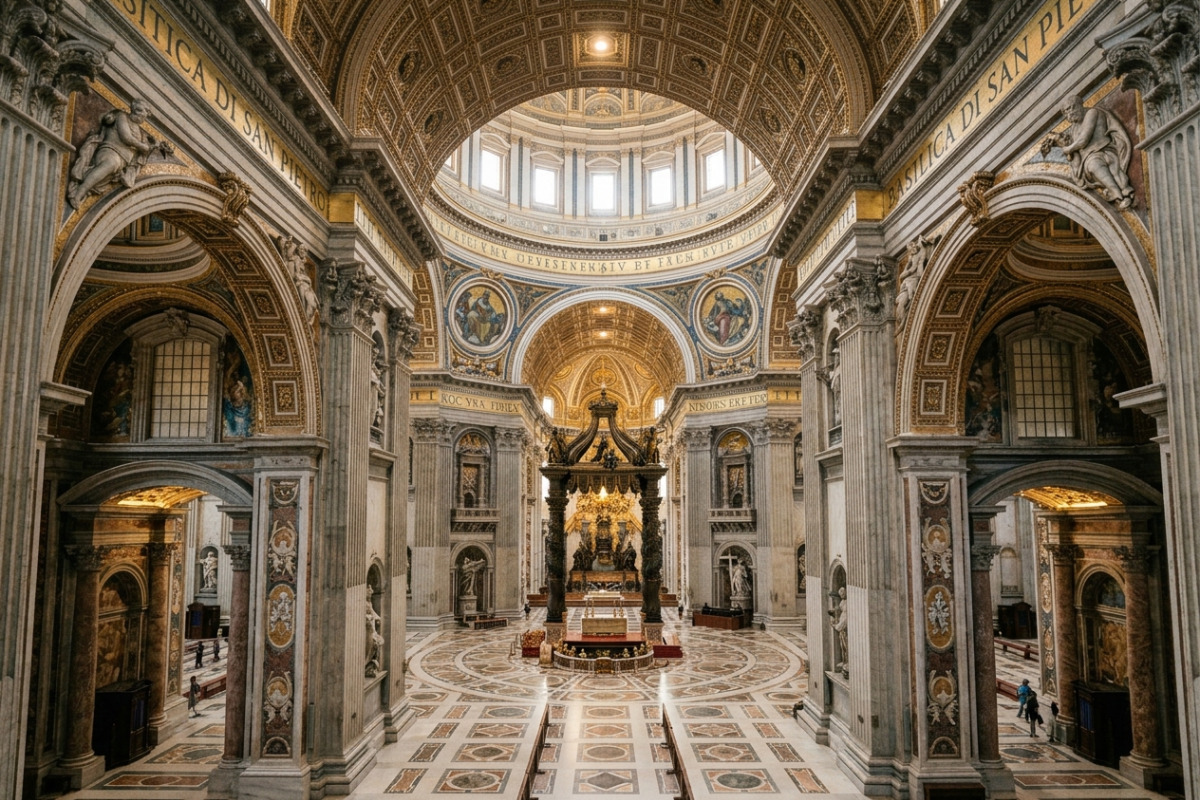
However, the needs of the liturgy eventually demanded a change in geometry. A central plan, while philosophically perfect, struggled to accommodate large congregations and processions. The eventual extension of the nave by Carlo Maderno transformed the space into a Latin Cross. This elongation created a distinct axis, a physical line of travel that pulls the visitor from the entrance toward the sacred heart of the church. To truly understand this layout, one should take the time to explore the Basilica with an eye for these transitions, noticing where the long, marching rhythm of the nave suddenly opens up into the vast, soaring space of the crossing. Maderno's extension, while altering Bramante's original vision, addressed the practical requirements of the Catholic Church, allowing for grand processions and a more traditional liturgical arrangement.
Axial Alignments: Orchestrating Movement
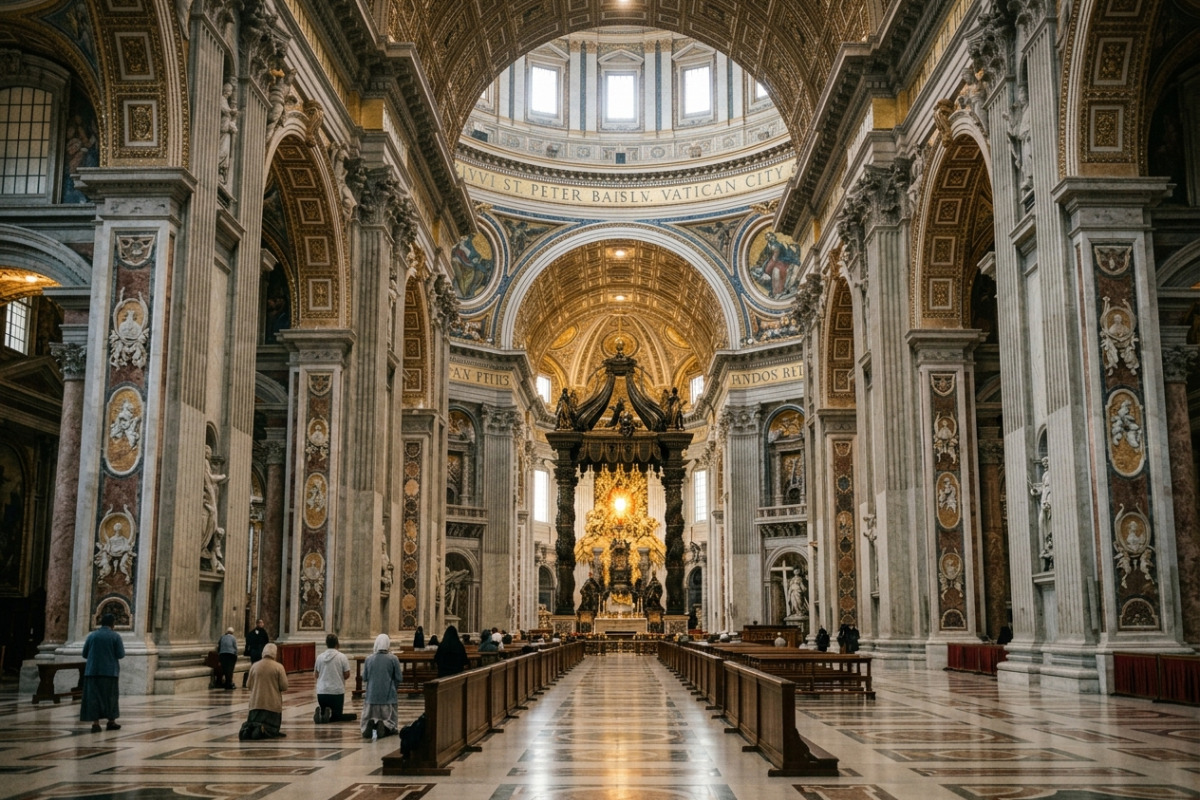
Geometry in St. Peter’s is not static; it is kinetic. The architecture utilizes axial alignments to control how you move and what you see. From the moment you pass through the massive bronze doors, the architecture commands you to look forward. The heavy piers of the nave act as rhythm markers, creating a tunnel vision that focuses intently on the distant Baldachin. This is intentional perspective at work, a technique used to make the journey to the altar feel like a spiritual ascent.
Secondary Axes: Moments of Reflection
While the main axis dominates, the basilica is filled with secondary geometric pockets that invite pause and reflection. For instance, just to the right of the entrance, the geometry shifts to a smaller, more intimate scale at the Chapel of the Pietà. Here, the focus is not on the grand axis but on a triangular composition of sorrow and beauty. A visit to Michelangelo's Pietà offers a moment of stillness before one rejoins the powerful forward momentum of the central nave. These side chapels act as geometric counterpoints, balancing the driving force of the main corridor with spaces of static contemplation.
The Dome: The Vertical Axis of Heaven
If the nave represents the horizontal journey of the faithful on earth, the dome represents the vertical axis connecting them to the divine. Michelangelo’s design for the dome was a masterstroke of structural geometry. He utilized a double-shell construction, a geometric solution that allowed for a profile that was both majestic on the outside and soaring on the inside. The interplay between the circular drum and the ribbed vault draws the eye upward, lifting the viewer’s gaze from the horizontal plane to the heavens.
Michelangelo's Geometric Genius: A Double-Shell Design
Standing directly beneath the dome offers a profound sense of scale that numbers alone cannot convey. The circle of the dome sits upon the square of the crossing, a classic architectural metaphor for the transition from the terrestrial (square) to the celestial (circle). For those who wish to understand the physics and geometry behind this feat, a visit to The Dome is essential. Climbing to the cupola not only provides panoramic views of Rome but also reveals the intricate geometric patterns of the mosaics up close, showing how the curvature was calculated to correct visual distortion from the ground.
Architectural Contributions to Geometry
The basilica is a palimpsest of designs, where different architects layered their geometric visions over one another. This collaboration across time resulted in a complex spatial language.
| Architect | Geometric Focus | Key Contribution |
| Donato Bramante | The Circle & Square | Proposed the original Greek Cross plan, emphasizing perfect symmetry and a massive central dome. |
| Michelangelo | The Vertical Axis | Refined the central piers and designed the double-shell dome to create a soaring vertical connection to heaven. |
| Carlo Maderno | The Longitudinal Line | Extended the nave to form a Latin Cross, creating a processional path from the entrance to the altar. |
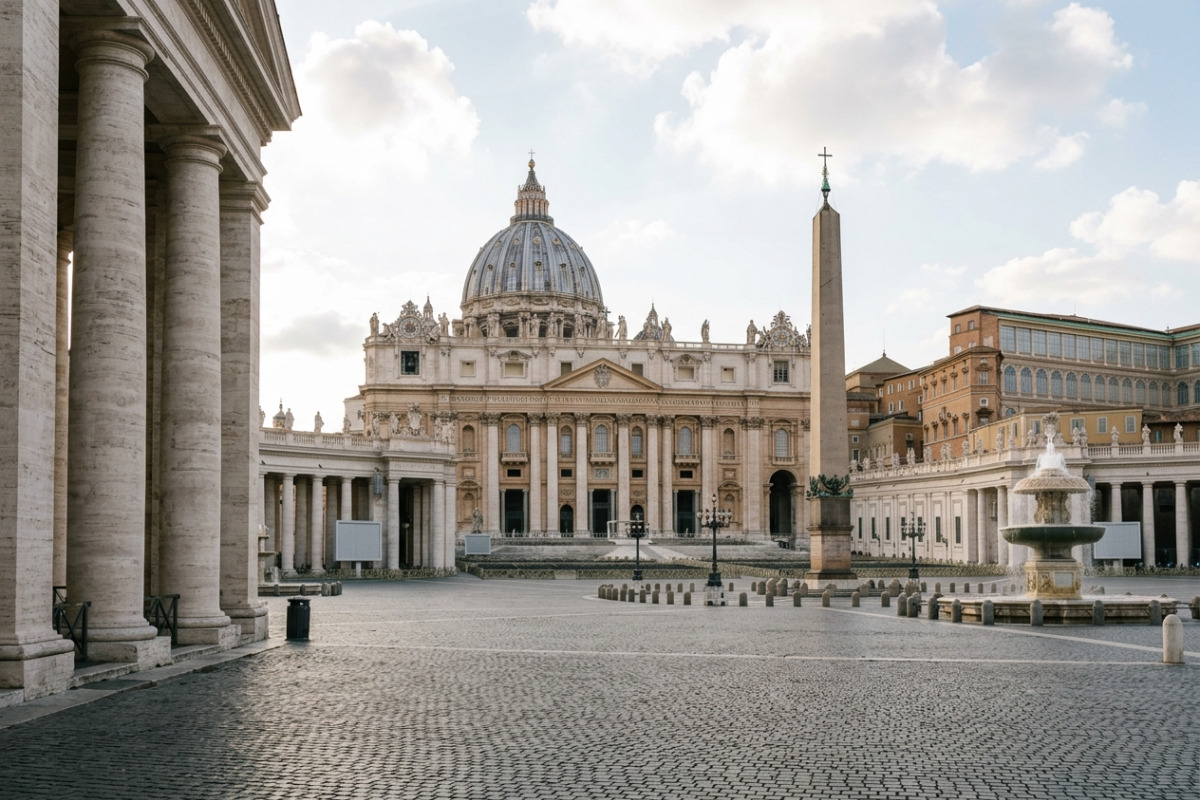
| Gian Lorenzo Bernini | The Oval & The Ray | Designed the colonnade outside and the Baldachin inside, introducing dynamic, theatrical curves and focal points. |
The Geometric Heart: The Confessio and Baldachin
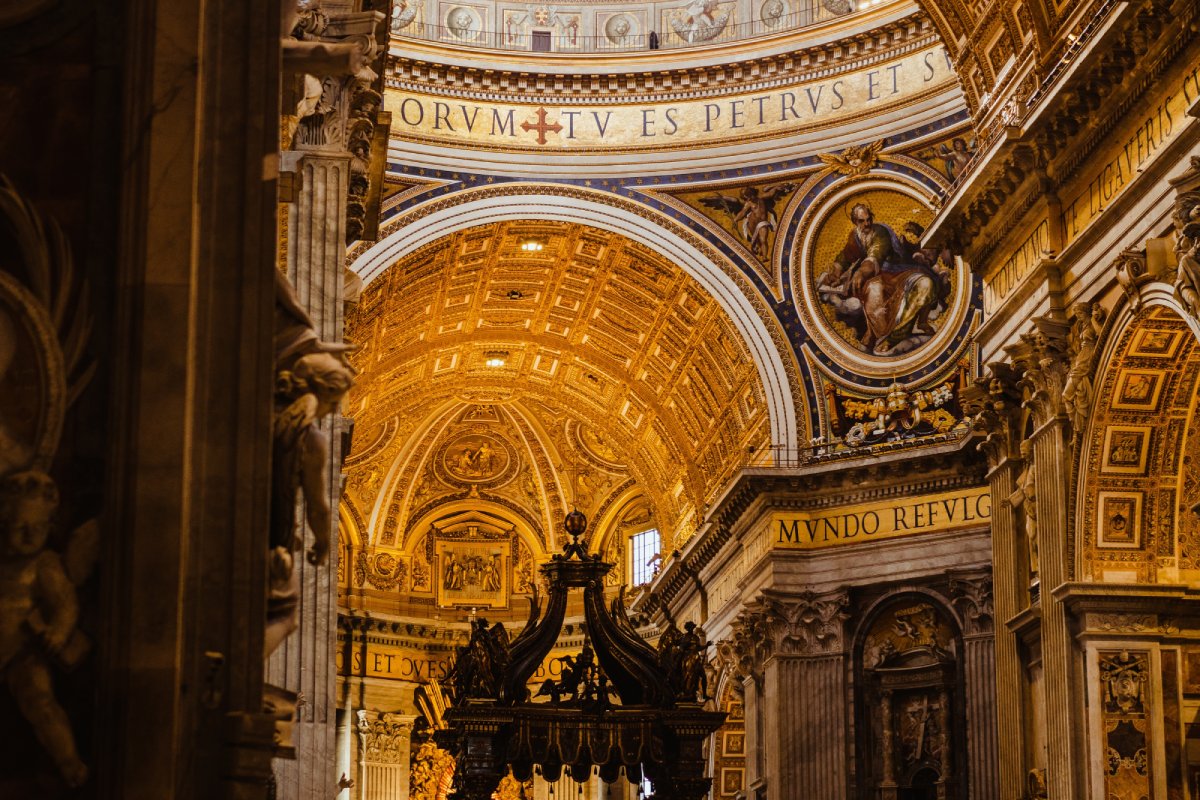
All lines in St. Peter’s Basilica eventually converge at one point: the Papal Altar. This is the geometric epicenter of the church. Gian Lorenzo Bernini’s bronze Baldachin marks this spot with twisting solomonic columns, a spiral geometry that contrasts sharply with the straight lines of the surrounding architecture. This spiral motion visually connects the altar below to the dome above, acting as a vertical conduit for the viewer's eye.
Bernini's Baldachin: A Spiral Ascent
Beneath this artistic triumph lies The Altar of the Confessio, a sunken chapel that brings the visitor closer to the physical foundation of the church—the tomb of St. Peter. The geometry here becomes subterranean, rooting the soaring structure above into the history of the earth below. For a deeper understanding of these layers, many visitors choose to explore The Necropolis, where the ancient streets and tombs reveal the original ground level upon which this massive geometric puzzle was constructed.
Symbolism in Numbers and Mosaics
The geometry of St. Peter's extends to the smallest details, including the intricate mosaic work. The interior contains virtually no paintings; what appears to be paint is actually thousands of tesserae. The placement of these mosaics is governed by strict geometric grids to ensure they catch the light and are visible from the floor. You can learn more about this meticulous craft at The Mosaic Studio, where the tradition of restoration continues today.
Sacred Numbers and Divine Proportions
Furthermore, the basilica is laden with numerical symbolism. The repetition of the number three (for the Trinity) and eight (symbolizing resurrection and new beginnings) can be found in the grouping of columns, the shapes of windows, and the octagonal forms within the ceiling coffers. Even the sacred objects housed in The Treasury Museum reflect this obsession with sacred proportions, where reliquaries and chalices were crafted using the Golden Ratio to reflect divine beauty.
Planning Your Architectural Pilgrimage
To truly appreciate the spatial language of St. Peter's, one must move through it slowly. It is not enough to simply walk down the center; one must engage with the side aisles, the chapels, and the subterranean levels. A visit to The Vatican Grottoes offers a look at the architectural footprint of the old Constantinian basilica, providing a stark geometric contrast to the Renaissance giant above.
For those planning a visit, here are a few tips to maximize your understanding of the architecture:
- Secure Access Early: The lines can be long. It is wise to check Tickets & Tours options in advance to ensure you have time to explore at your own pace.
- Use an Audio Companion: The visual language is complex. Using the Audio Guide App can help decode the history behind the alignments and structural feats you are seeing.
- Check Logistics: Before heading out, review Plan Your Visit for dress codes and entry points, as these practicalities ensure a smooth entry into the sacred space.
- Clarify Doubts: If you are unsure about photography rules or accessibility to the dome, the Frequently Asked Questions page is an excellent resource.
Conclusion: A Symphony of Geometry and Faith
St. Peter's Basilica stands as a testament to the power of geometry to shape not only physical space but also spiritual experience. The interplay of circles, squares, and axes, orchestrated by visionary architects across centuries, creates a journey that transcends mere sightseeing. It is an invitation to contemplate the divine through the language of form and proportion. From the grand sweep of the nave to the intricate details of the mosaics, every element contributes to a unified whole, a spatial narrative that resonates with both the intellect and the soul. The Basilica is more than a building; it is a living embodiment of faith expressed through the timeless principles of geometry.