When you stand before the grandeur of St. Peter’s Basilica, you are not merely looking at a church; you are witnessing the physical embodiment of the Renaissance spirit. This was an era that sought to revive the glory of classical antiquity, blending it with Christian spirituality to create something entirely new and breathtaking. The construction of the Basilica was not a swift project but a century-long odyssey that saw the baton passed between the greatest artistic minds of history. From the early sketches of Bramante to the towering dome of Michelangelo, the design of the Basilica tells the story of a world waking up to the power of human potential, symmetry, and divine proportion. It represents a shift from the soaring, shadowy verticality of the Gothic style to the rational, light-filled, and massive forms of Roman antiquity.
The transformation began in the early 16th century when Pope Julius II made the audacious decision to demolish the crumbling Old St. Peter’s, which had stood since the time of Emperor Constantine. He envisioned a monument that would surpass all others in Christendom, serving as a symbol of the Church's power and the artistic rebirth of Rome. This decision set in motion a chain of architectural events that would redefine the skyline of the Eternal City forever. To truly understand this masterpiece, one must look at the specific figures who shaped its stones and the philosophical ideals that guided their hands.
The Birth of a Humanist Vision: Bramante’s Plan
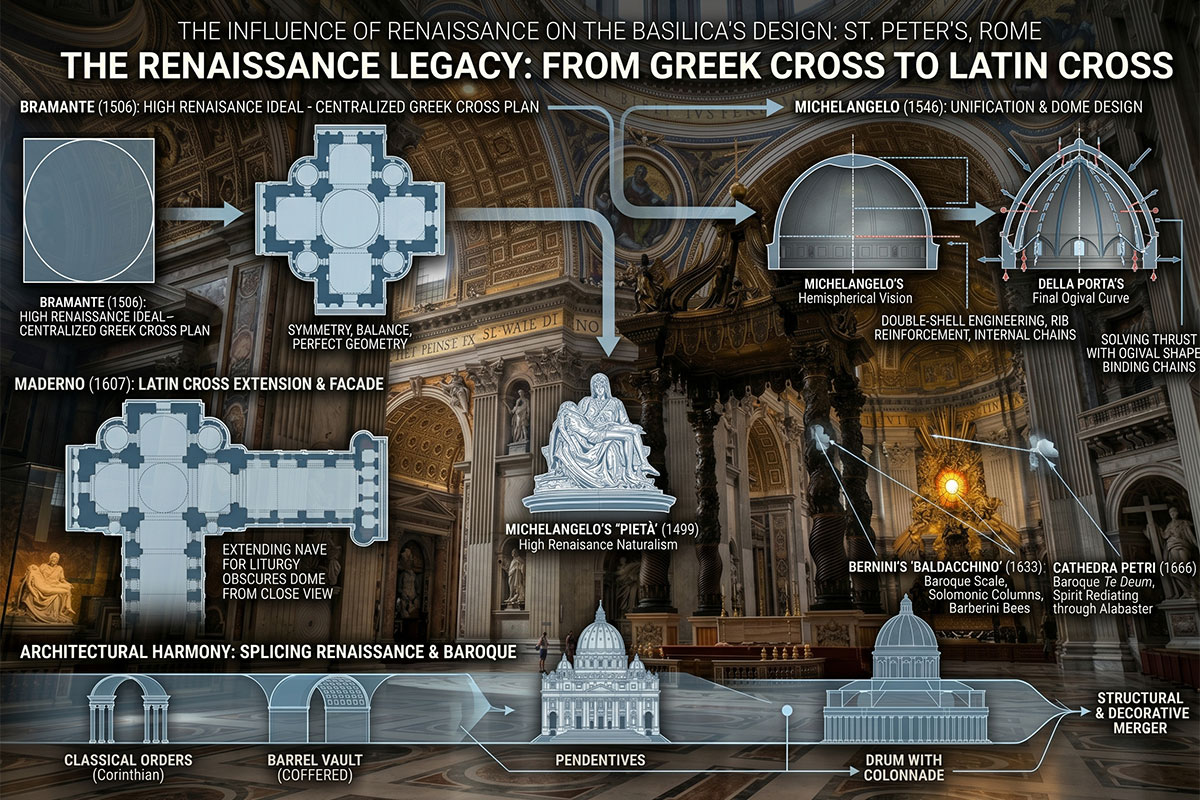
The first architect to leave an indelible mark on the new Basilica was Donato Bramante. His vision was radical and purely Renaissance in nature: he proposed a Greek Cross plan—a central layout with four arms of equal length—surmounted by a massive central dome. This design was not chosen arbitrarily; in the Renaissance mind, the circle and the square represented geometric perfection and the harmony of the cosmos. Bramante wanted the Basilica to be a perfect reflection of God's order, moving away from the traditional Latin cross layout that had dominated medieval church building. His plan was intended to rival the Pantheon, placing the dome of the ancients upon the scale of the Christian world.
Bramante's ambition extended beyond mere geometry. He meticulously studied ancient Roman building techniques, seeking to recapture the grandeur of structures like the Baths of Caracalla. His use of travertine stone, quarried near Rome, echoed the materials of the emperors, further connecting the Basilica to the classical past. He also pioneered the use of innovative construction methods, including the creation of massive foundations capable of supporting the immense weight of the dome. Imagine the sheer scale of the undertaking: moving tons of stone and earth with the technology of the early 16th century. This required not only architectural genius but also logistical mastery.
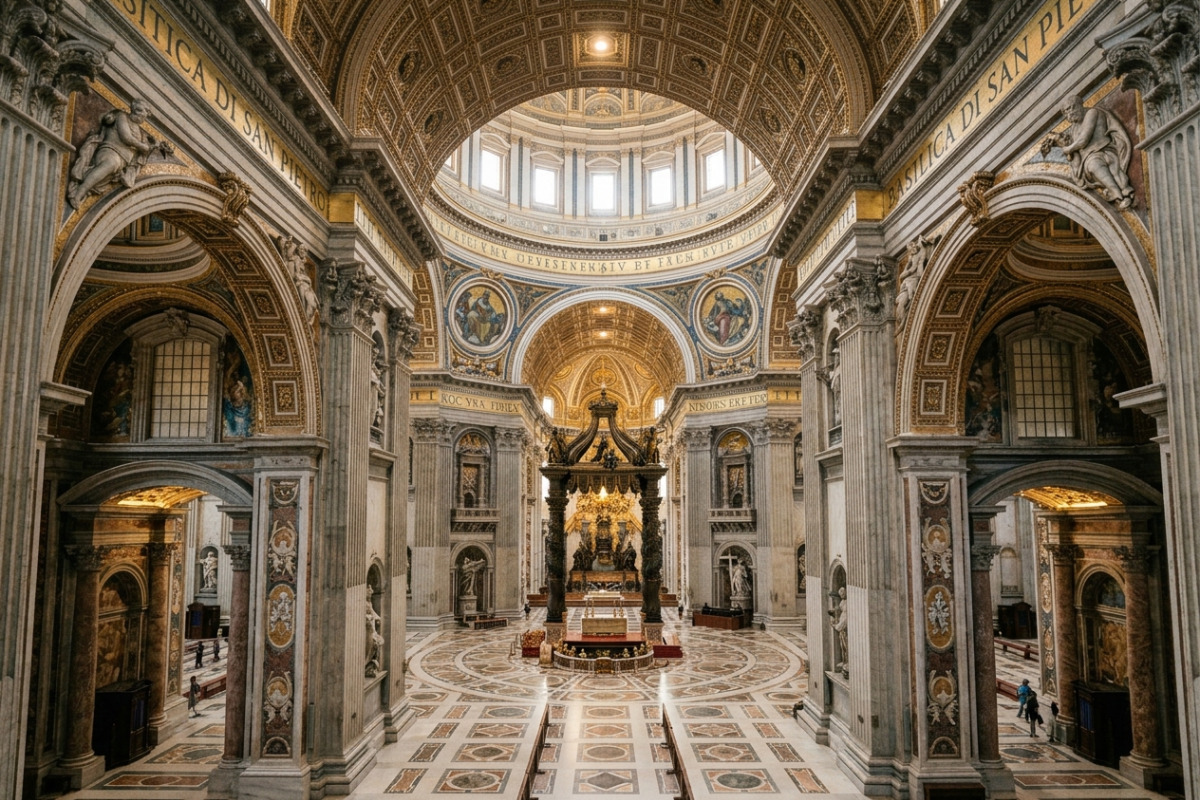
Although Bramante died before his vision could be fully realized, the four massive central piers that support the dome today are his legacy. These structural giants determined the scale for everyone who followed. While touring the interior, if you look closely at the architecture surrounding The Altar of the Confessio, you are standing in the heart of Bramante’s original concept. His focus on symmetry and volume set the stage for the monumental nature of the building, ensuring that even as plans changed, the core of St. Peter's would remain a testament to High Renaissance ideals.
Michelangelo and the Triumph of the Dome
Following a period of uncertainty and changing architects, including Raphael and Antonio da Sangallo the Younger, the project was handed to Michelangelo Buonarroti in 1546. By this time, Michelangelo was already an elderly man, yet he brought a vigor to the project that saved it from architectural confusion. He returned to Bramante’s central Greek Cross plan but simplified it, thickening the walls and unifying the interior space to support the most iconic feature of the skyline: the dome. Michelangelo’s vision was one of tension and energy; he wanted the building to feel like a cohesive, organic sculpture rather than a collection of separate parts.
Michelangelo's approach was deeply personal and infused with his artistic sensibilities. He saw the dome not just as a structural element but as a sculptural masterpiece, a testament to human skill and divine inspiration. He meticulously refined Bramante's original design, increasing the height and curvature of the dome to create a more dynamic and awe-inspiring silhouette. He also simplified the exterior, removing some of the decorative elements to emphasize the dome's pure form. His artistic genius extended to the smallest details, from the design of the windows to the placement of the statues. Every element was carefully considered to contribute to the overall harmony and grandeur of the Basilica.
The dome itself is perhaps the ultimate symbol of Renaissance engineering and aesthetics. It was designed to be a beacon visible from across Rome, a feat that required pushing the boundaries of physics and masonry. While Michelangelo did not live to see the dome completed, his detailed designs ensured its execution. Today, visitors can ascend this architectural marvel. A visit to The Dome offers not just a view of the city, but a close-up look at the double-shell construction that influenced majestic buildings worldwide, from London to Washington D.C. Furthermore, Michelangelo’s influence is felt deeply within the nave, where his early masterpiece, Michelangelo's Pietà, resides—a sculpture that perfectly encapsulates the Renaissance focus on human anatomy and emotional realism.
Architectural Evolution: A Timeline of Genius
The construction of St. Peter's was a collaborative effort across generations. The following table highlights the key architects and their specific contributions to the Renaissance and early Baroque transitions of the Basilica:
| Architect | Period | Key Contribution | Style Influence |
| Donato Bramante | 1506–1514 | Original Greek Cross plan, central piers. | High Renaissance (Symmetry & Geometry) |
| Raphael | 1514–1520 | Proposed extending to a Latin Cross (unrealized). | High Renaissance |
| Michelangelo | 1546–1564 | Design of the Dome, simplification of the Greek Cross. | Late Renaissance / Mannerism |
| Carlo Maderno | 1603–1629 | Facade and extension of the Nave (Latin Cross). | Transition to Baroque |
| Gian Lorenzo Bernini | 1629–1680 | St. Peter's Square, Baldachin, Interior decoration. | Baroque |
The Transition to Baroque: Maderno and Bernini
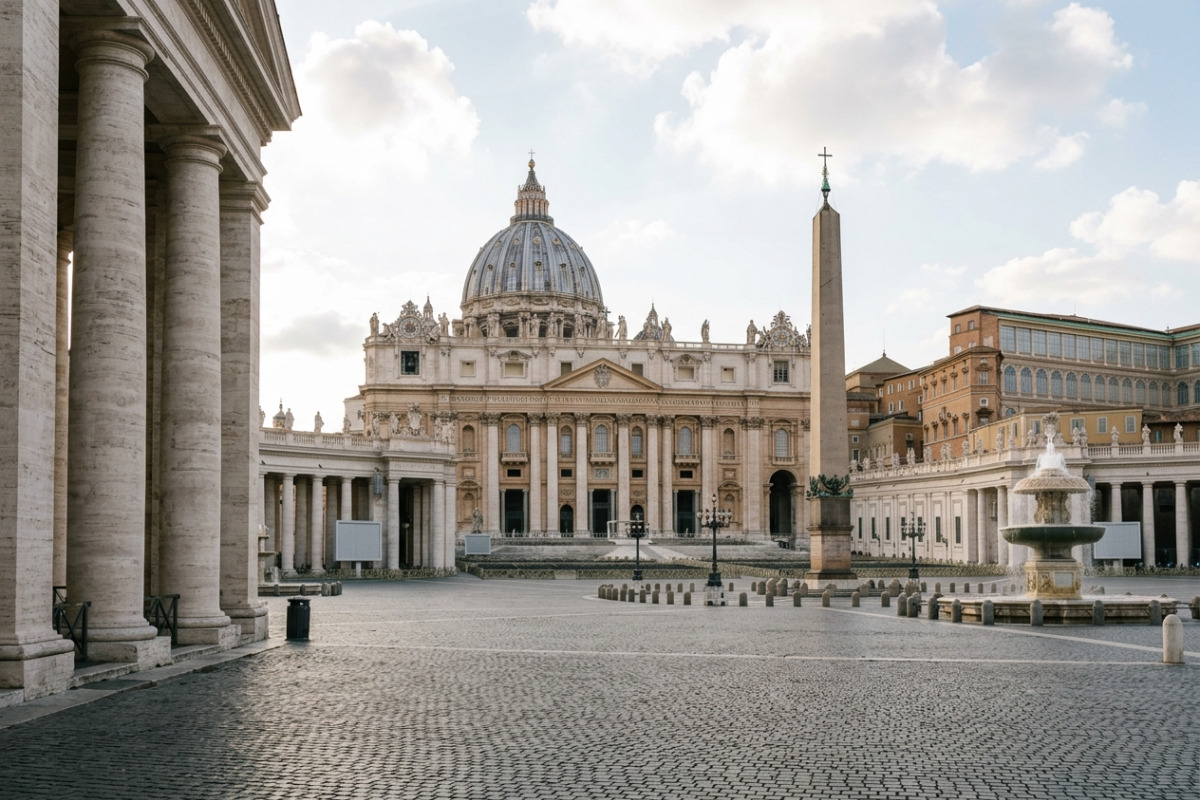
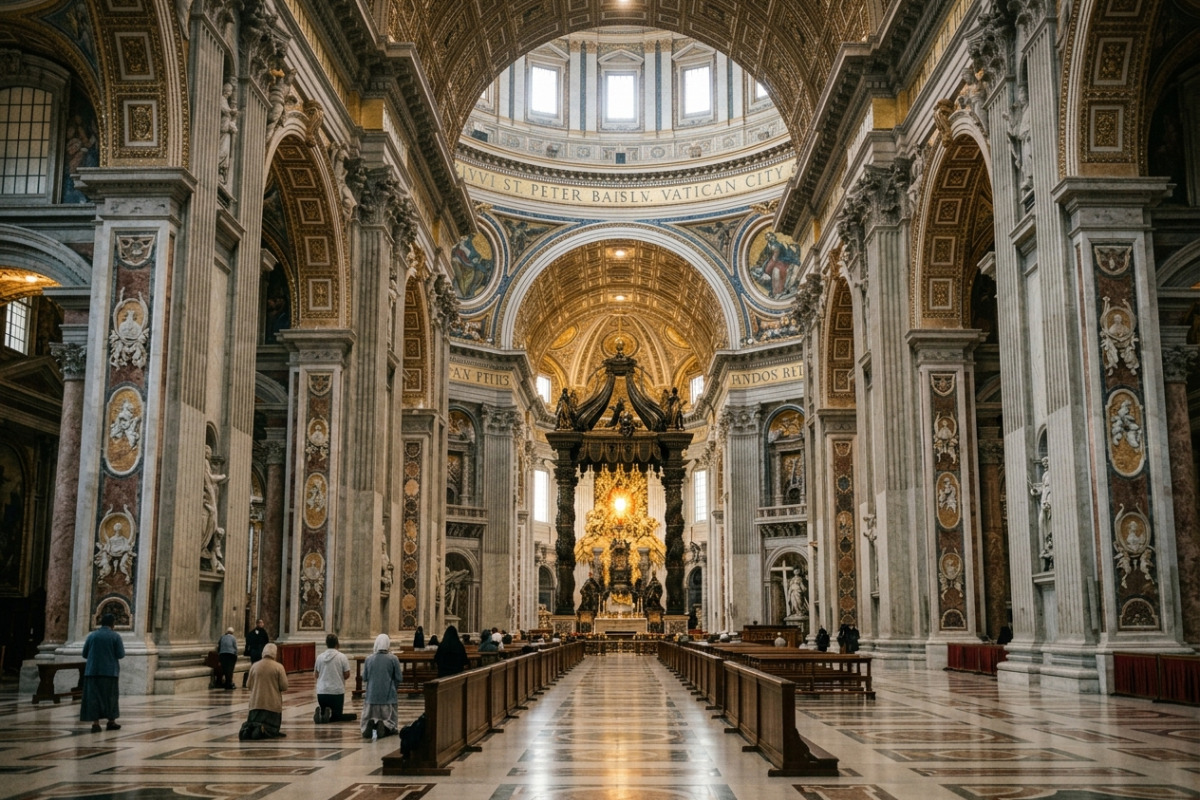
As the Renaissance waned and the Counter-Reformation took hold, the needs of the Church changed. The clergy required a building that could hold massive congregations for processions, something the central Greek Cross plan struggled to accommodate. In the early 17th century, Carlo Maderno was tasked with extending Michelangelo’s building into a Latin Cross (a long nave). This addition shifted the architectural balance, creating the long, majestic entrance we see today. While this extension somewhat obscures the view of the dome from the square, it provided the grandeur necessary for major liturgical events. You can explore the vastness of this nave by using the Audio Guide App, which details the shift in perspective as you walk from the entrance toward the altar.
Maderno's contribution, while necessary, represented a departure from the pure Renaissance ideals of his predecessors. He faced the challenge of integrating the existing structure with the new nave, striving to maintain a sense of harmony and proportion. He incorporated elements of both Renaissance and Baroque styles, creating a transitional space that reflected the changing artistic landscape of the time. His facade, with its colossal columns and intricate ornamentation, set the stage for the Baroque splendor that would follow.
Following Maderno, Gian Lorenzo Bernini brought the dramatic flair of the Baroque era to the Basilica, completing the transition from the static harmony of the Renaissance to dynamic theatricality. Bernini’s massive bronze Baldachin stands directly under Michelangelo’s dome, visually bridging the gap between the human scale of the congregation and the soaring heights of the Renaissance ceiling. His work extended outside as well; the famous colonnade of St. Peter’s Square was designed to embrace pilgrims like "the maternal arms of Mother Church." For those interested in the artistic treasures housed within these walls, a visit to The Treasury Museum reveals the ornate liturgical objects that complemented this new architectural grandeur.
Artistic Integration and Hidden Layers
The Renaissance influence on St. Peter’s is not limited to its walls and domes; it permeates every surface through mosaics and statuary. Unlike medieval churches often adorned with frescoes, the humid environment of the Basilica led to the establishment of a specialized workshop to recreate paintings in intricate mosaic form. This ensured the longevity of the Renaissance imagery. Visitors can learn more about this meticulous craft by visiting The Mosaic Studio, where the tradition continues today. The interplay of light, colored stone, and gold leaf was calculated to inspire awe and reflect the divine light, a core concept of Renaissance theology.
Furthermore, the Renaissance respect for history and lineage is evident in how the new Basilica honored the old. The construction required deep foundations that cut into the Vatican Hill, preserving the sacred site of St. Peter’s tomb. Today, you can journey beneath the Renaissance floor to see these historical layers. The Vatican Grottoes contain the tombs of popes and kings, while deeper still lies the ancient Roman history. For the most dedicated history enthusiasts, a specialized tour of The Necropolis reveals the pagan and early Christian roots upon which the Renaissance masterpiece rests.
Experience the History
Understanding the architectural evolution of St. Peter’s Basilica transforms a simple visit into a journey through time. You are walking through the realized dreams of Bramante, staring up into the genius of Michelangelo, and surrounded by the drama of Bernini. To fully appreciate the scale and the intricate details of this design evolution, it is highly recommended to plan ahead.
- Secure Your Entry: Long lines are common. Checking Tickets & Tours in advance allows you to maximize your time exploring rather than waiting.
- Map Your Route: The Basilica is immense. Reviewing Explore the Basilica helps you prioritize key areas like the Dome or the Altar.
- Know Before You Go: Dress codes and opening hours are strictly enforced. Read through Plan Your Visit and the Frequently Asked Questions to ensure a smooth experience.
St. Peter's Basilica remains the ultimate case study of how the Renaissance changed the world. It moved architecture from the realm of the artisan to the realm of the intellectual, creating a space that connects the earth to the heavens through perfect geometry and breathtaking beauty.